

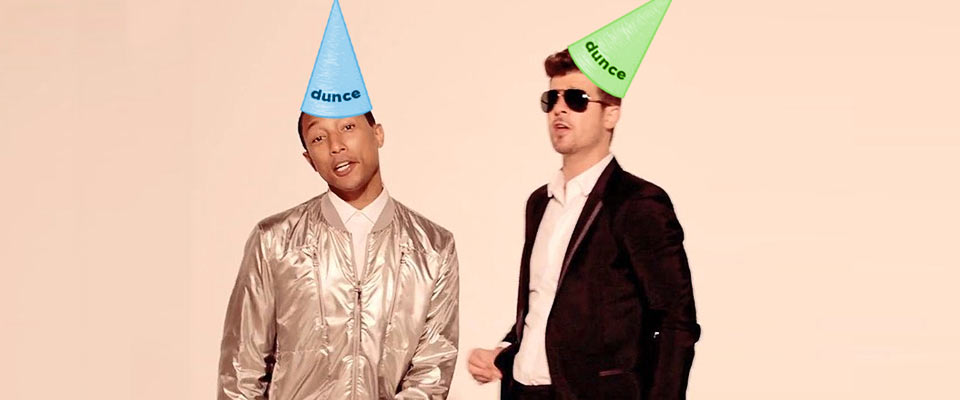
Two seconds into my first listen of “Blurred Lines” by Robin Thicke and Pharrell, I immediately thought it was a knockoff version of Marvin Gaye’s “Got To Give It Up”. Clearly I wasn’t alone, as a jury found them guilty of copyright infringement and awarded Gaye’s estate $7.3 million.
I’ve seen opinions on both sides: some say “you can’t copyright a genre” and “The Gaye Family was just looking for a come-up”; others say “they clearly stole the song”. I respect both Robin and Pharrell immensely… but they lost this one as soon as “Blurred Lines” was released.
REASON#1: Robin Thicke basically said it himself:
Pharrell and I were in the studio and I told him that one of my favorite songs of all time was Marvin Gaye’s “Got to Give It Up.” I was like, “Damn, we should make something like that, something with that groove.”
REASON #2: Instead of going the Sam Smith route and giving credit where it’s due, Williams and Thicke preemptively sued the Gaye Estate to try to avoid what just happened.

Even though EVERYONE knew where their “inspiration” came from, the odds were still largely in their favor: (1) Copyright infringement lawsuits are hard to even get to trial, let alone win, (2) The Gaye family represents the copyright of the musical composition of “Got To Give It Up”, not the sound recording, (3) You can’t copyright drum patterns, and the sonic inflections from the recording wouldn’t be found on the sheet music, and (4) Williams and Thicke successfully got Marvin Gaye’s recording of “Got To Give It Up” banned from being played in the proceedings. The jury could only rule on what could be found on the sheet music. Later, they allowed a stripped-down version of the song to be played.
Their lawyers played every card they had. And they still lost.

My Thoughts
I took a beatmaking class in college and one of the exercises (aside from how to recreate Hip-Hop songs using their original samples) was how to successfully interpolate a song. It’s easy to go one step further and just switch up the melody to avoid paying. Tons of television shows and films do this: you’ll be watching a party scene and think “this sounds just like (insert hit song)”. That’s was the goal.
A lot of composers make a lot of money replicating pop songs and changing them just enough to avoid infringement, mostly at the request of TV/Film productions so they save money in licensing fees. Why pay $500,000 for a 30-second clip playing in the background of a club scene when you can pay $1,500 for a sound-alike?

This is my theory on what happened: they wanted a song that sounded like “Got To Give It Up”, so they re-created the groove, then wrote new lyrics and melody. It isn’t the first time it’s been done, but they got entirely too close to the original.
I’m all about giving the benefit of the doubt, but I lost all sympathy for them when I saw the following quote from their lawyer, used as an actual defense point: “Why would Mr. Williams need to copy anyone to create a hit?”

What’d We Learn?
Copyright infringement is extremely hard to prove, and the burden is on the original copyright owners (especially in this case). Yet, when nearly everyone can pinpoint the song that you “drew inspiration from”, you have a problem.
Look, technically it’s not plagiarized. It’s not the same chord progression. It’s a feeling. Because there’s a cowbell in it and a fender Rhodes as the main instrumentation — that still doesn’t make it plagiarized. We all know it’s derivative. That’s how Pharrell works. Everything that Pharrell produces is derivative of another song — but it’s an homage.
Do I believe they committed copyright infringement? Technically, no. But, the law is grey in cases like this.
Some think this will change copyright law, but I highly doubt it. Cases like this are fought in court all the time, but the law mainly remains the same. Nevertheless, Robin Thicke and Pharrell learned the hard way: “borrowing” major elements of a song without giving proper credit is a quick way to get sued.
Articles to read:
- Rolling Stone: Robin Thicke, Pharrell Lose Multi-Million Dollar ‘Blurred Lines’ Lawsuit
- Vox: Jury rules Robin Thicke and Pharrell Williams stole “Blurred Lines.” Here’s what that means.
- Wallace Collins: “Blurred Lines” Decision Could Be Overturned On Appeal
Addendum – 3/12/15
To everyone saying that the “Blurred Lines” verdict sets a dangerous precedent over creativity and copyright law, I have three words: no it doesn’t. The line between inspiration and infringement is thin. Some come close to crossing it. “Blurred Lines” hurdled over it and feigned ignorance.
This was a unique case that could have been avoided if the writers/publishers of “Blurred Lines” had been scrupulous and negotiated with the publishers of “Got To Give It Up” before its release. Instead, they created a derivative work of a classic song, didn’t clear it, got cocky, pre-emptively sued Marvin Gaye’s estate, then started backpedaling and switching stories when their suit was denied and the case went to trial.
Will there likely be more copyright infringement lawsuits like this? Not more than there already are. Will this judgment be appealed? Probably. Will there be more wins like this? Probably not.
